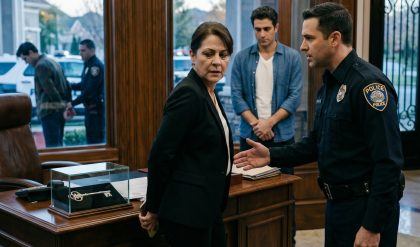
The sirens died, leaving a silence that felt heavier than the desert heat. As the police officers crossed the patio, their presence didn’t just crowd the space; it dismantled it. The upscale home, once a stage for Daniel’s performance of domestic dominance, was now a crime scene.
Daniel’s face was a masterclass in failing composure. He looked at the officers, then back at me, his eyes darting like a trapped bird. “This is a misunderstanding,” he began, his voice losing its polished veneer and dropping into a jagged, desperate tone. “She wasn’t locked out. We were just… we were having a private family discussion. She’s prone to these—these outbursts.”
He reached for me, his hand outstretched in a gesture meant to appear conciliatory, but he stopped short when one of the officers stepped firmly between us.
“Mr. Mercer,” the officer said, his voice clipped and professional. “Step back. We have statements to take, and based on the initial assessment, there are some concerning questions regarding the timeline of this afternoon.”
I watched him. I watched the man who had spent three years calculating exactly how much cruelty I could endure before I broke. He looked at the paramedics hovering over me, then at the neighbors who had finally drifted to their fences, their faces obscured by the shadows of the evening. For the first time, he wasn’t looking for a way to win the argument; he was looking for a way to remain relevant.
“Claire,” he called out, his voice thin. “Tell them. Tell them you’re happy here. Tell them everything we have.”
The word have hung in the air. He didn’t say we love, he didn’t say we share. He said have.
“We have nothing, Daniel,” I said, my voice gaining strength with every syllable. “You have a house. You have an audience. And you have a recording of your own indifference.”
I turned to the officer. “My brother has the logs from my phone. I triggered the emergency protocol because I was denied medical access while suffering from heat exhaustion. That video on her phone?” I nodded toward Vivian, who looked as if she had suddenly aged ten years. “It’s not for their protection. It’s their confession.”
Vivian’s phone clattered against the stone floor as she tried to hide it, but the officer was faster. He picked it up, glancing at the screen before tucking it into an evidence bag. The look he gave them—cold, clinical, and completely unimpressed—was the final nail in the coffin of their manufactured reality.
As the paramedics began moving me toward the waiting ambulance, I didn’t look back at the kitchen. I didn’t look at the grill or the steak that had long since charred. I felt the baby shift, a gentle, rhythmic movement that signaled the end of our season of hiding.
Daniel was left standing on his pristine patio, surrounded by people who were no longer listening to his story. He was still trying to talk, still trying to command, his hands gesturing to the empty air, but the witnesses had arrived. The gate was open. The world was watching, and for the first time in years, he was no longer the one holding the lock.
As the ambulance doors slid shut, sealing out the heat and the dust, I closed my eyes. The silence that remained behind wasn’t empty. It was the sound of a story finishing, and a life finally, mercifully, beginning.
THE END